Istria & Kvarner Wine Regions Guide
Istria: The Spiritual Home of Croatian Wine.
Introduction
Croatia’s northernmost wine region, Istria, exemplifies the Adriatic ideal: rows of vineyards, olive groves, pristine beaches, and a deep, turquoise sea. For wine lovers and professionals alike, its attractions are numerous, including a rich repository of indigenous grape varieties, not least the sumptuous Malvazija Istarska – quite unlike Malvasia tout court. Producing generous, full-bodied white wines of enormous food-matching potential, it has become emblematic of Istria’s vibrant food and wine culture. Often compared to Tuscany – minus the tourists – Istria has a viticultural history that dates back over two millennia, influenced by the Greeks, Romans, and, above all, the Venetians.
Yet despite its stunning natural beauty, Istria is far more than simply a picture-postcard destination. It is home to hundreds of winegrowers – a working vineyard of great economic importance to the wider community. A visit reveals modest enterprises, artisan-driven winemaking, and a palpable sense of hard work. Welcome to the spiritual home of Croatian wine.
Geography and terroir
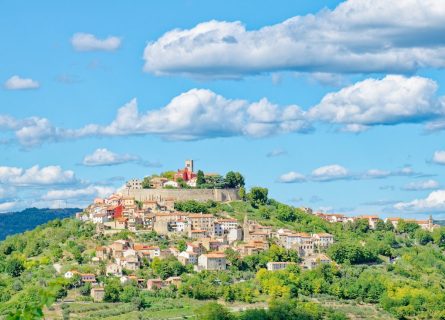
Few other European vineyards can rival Istria’s scenic beauty and range of native grape varieties. The region, a large, triangular peninsula jutting into the Adriatic, is bordered by Slovenia to the north and the Kvarner Gulf to the east. For centuries, growers have cultivated vines in a patchwork of fertile valleys, undulating hills (similar to Tuscany), and coastal plains facing the Adriatic Sea.
Climatically, the region benefits from mild winters and warm summers, tempered by maritime breezes that help preserve acidity and freshness in the wines. Indeed, Istria’s plentiful sunshine, exceptional soils, and moderate rainfall make it one of the most favorable viticultural zones in the Balkans.
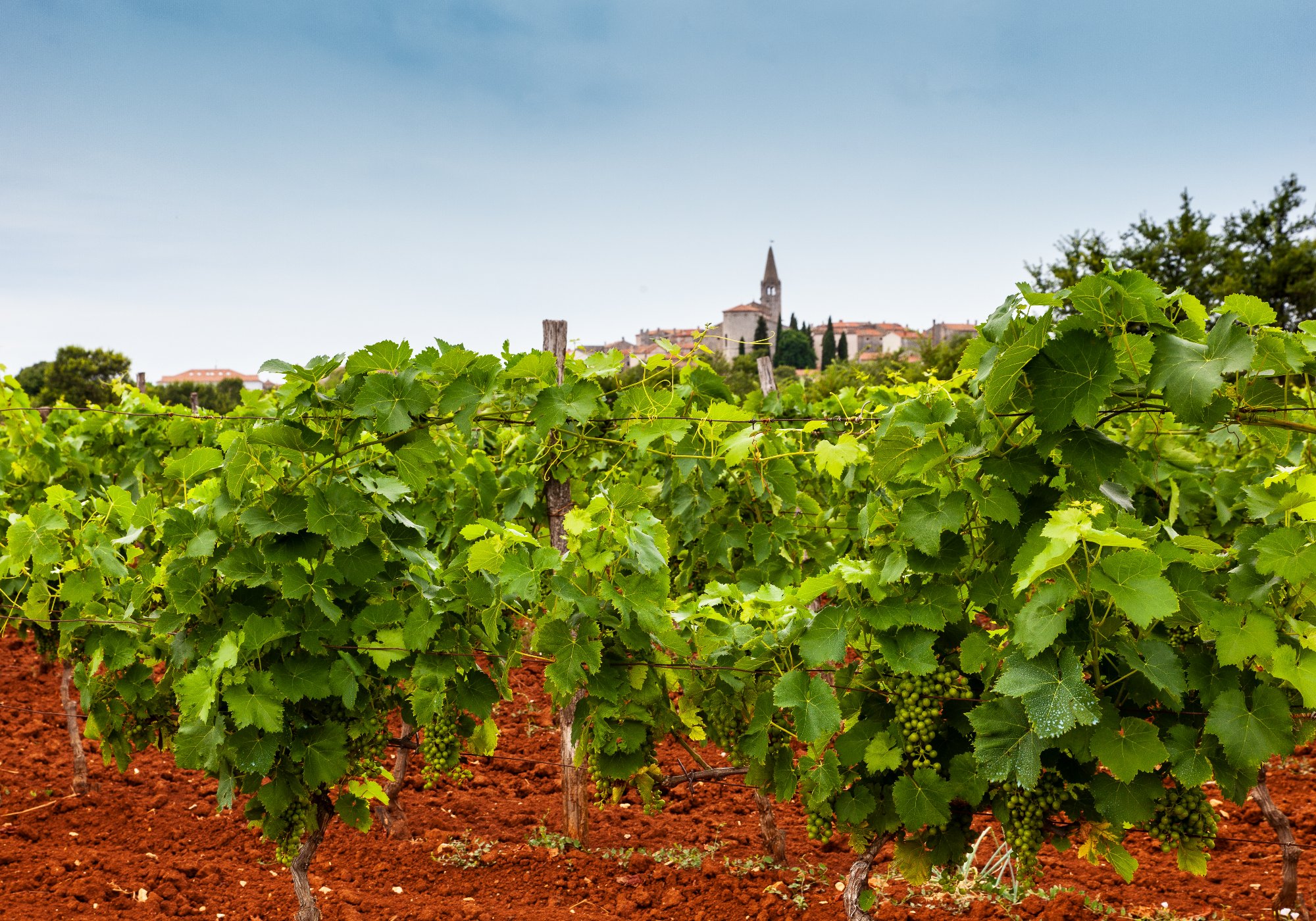
Istria has traditionally been divided into three subregions: Red Istria, Grey Istria, and White Istria. Red Istria, located on the coast and in lower-lying western areas, derives its name from the terra rossa soils rich in iron – perfect for red varieties like Teran. Meanwhile, Grey Istria is a zone farther inland, centered on the villages of Motovun and Buzet. Its marl and flysch (types of sedimentary rock) terroirs yield very aromatic, structured white wines, particularly Malvazija Istarska and Pinot Gris. Finally, White Istria is a spectacular subzone on the eastern side of the peninsula, with vines planted in the foothills of the majestic Učka mountains. Limestone soils, combined with the significant diurnal temperature variation, offer ideal conditions for white varieties that excel in this undulating landscape. It is this interplay of elevation, terroir, and mesoclimate that has maintained White Istria’s reputation as Croatia’s leading producer of exceptional dry whites.
The neighboring Kvarner Gulf extends Istria’s viticultural landscape. Encompassing a dramatic stretch of coastline and several islands, the maritime influence is at its strongest here: sea breezes, salt-laden air, and abundant sunshine produce mineral-scented whites of great charm. The native grape, Žlahtina, thrives on the pretty island of Krk, where it is grown almost exclusively. Planted on steep slopes overlooking the Adriatic, Zlahtina yields crisp, light, and aromatic wines that capture the essence of their maritime climate. There are also small pockets of Malvazija Istarska and Chardonnay on the mainland coast, along with a scattering of indigenous red grapes.
Over the past 25 years, Istria’s wine industry has undergone profound changes, with producers embracing sustainable tourism, lower-yield viticulture, and judicious site selection, benefiting both consumers and winemakers. It offers a unique and rare fusion of Adriatic sunlight, exceptional geology, and a balance of continental and maritime influences, delivering wines of vibrant fruit and bracing freshness. Today, Istria remains a linchpin of Croatian wine.
Winemaking and regional classifications
Much like Primorska in Slovenia, Istria specializes in producing aromatic, mineral-scented whites that pair wonderfully with local cuisine. Its trump card is Malvazija Istarska, one of Croatia’s greatest white grapes. Its golden hue, supple texture, and great complexity have made Malvazija an icon of modern Istrian viticulture, crafted in both sweet and dry styles.
And yet, Malvazija Istarska is not very well known outside of the Balkans, despite its many virtues. Indeed, it can surprise even seasoned oenophiles with its impressive versatility and penetrating depth: the texture of Viognier allied with the briskness of Vermentino, with a savory grip of its own. Historically, growers would use Malvazija Istarska to make large volumes of light, unexciting table wine, quaffed in the atmospheric wine bars of Rovinj and Pula.
However, over the past three decades, a revolution has transformed viticulture and winemaking, with ambitious producers embracing skin contact, spontaneous fermentation, and barrel aging to reveal the grape’s full potential. The result is a broad spectrum of styles, ranging from light and fresh to structured, phenolic wines capable of aging for at least 10 years.
Today, Giorgio Clai is a name spoken with reference across Istria. His devotion to minimal intervention winemaking has inspired countless young winemakers across Croatia, while sommeliers regard his wines as among the finest being made in the Balkans. Working organically, Clai rejects the standard paradigm of quick pressing and pure-juice vinification in a reductive environment. Instead, gentle oxidation and extractions are carefully harnessed to unlock deeper layers of flavor and texture, with natural yeast, whole bunches, and long macerations all playing their vital part.
SV. Jakov Malvazija is undoubtedly his finest creation. Hand-harvested fruit, taken from a 42-year-old single vineyard, is destemmed, crushed, and transferred to large wooden vats for a spontaneous fermentation using natural yeast. An extended maceration – about three months – yields a dry white of remarkable depth, matured in large oak barrels for an additional two years.
In the wrong hands, skin-contact winemaking can yield harsh tannins, oily textures, and rank mediocrity. But SV. Jakov Malvazika is a triumph: amber in color, it displays a glorious mosaic of honey, citrus, and fennel aromas, underpinned by a firm backbone and lovely freshness. It is alive with texture and nuance. It is unlike anything you have ever tried before.
Of course, not every producer follows this path. A certain percentage of local white is produced quickly and painlessly in stainless steel: well-made but bland wine for early consumption. Yet the best of Istria, exemplified by Giorgio Clai, stands unrivaled in Croatia today.
Facts & Figures
-
Key wine styles
- Aromatic, medium-bodied whites;
- Teran-based reds; international varieties;
- A small volume of sparkling wine
-
Appellation structure
- PDO (Protected Designation of Origin)
-
Hectares under vine
3,000
-
Average annual production
650,000 hectoliters per annum (Figure for total Croatian production)
-
Approximate number of producers
250 wineries
Key Grape Varietals
-
Red grape
Cabernet Sauvignon
Learn what Cabernet Sauvignon tastes like, where it grows best, why it matters in Bordeaux, and how to pair and serve this age-worthy red grape. View grape -
Red grape
Merlot
Merlot is the most cultivated grape in Bordeaux and closely related to Cabernet Franc View grape -
Red grape
Refosco
Unveil Refosco, Italy's secretive red wine family, with tannic, pungent wines. Explore its century-old mystery in our comprehensive guide. View grape -
Red grape
Syrah
Discover Syrah, from Northern Rhône classics to Shiraz, with flavor profile, regions, aging potential, and food pairings. View grape -
Red grape -
White grape Graševina (Welschriesling)
Croatia’s popular white grape. Fresh, dry, and easy-drinking, with apple, citrus, and gentle floral notes. -
White grape Malvazija Istarska
Istria’s signature white grape. Full, fresh, and food-friendly, with peach, almond, herbs, and a soft Mediterranean feel. -
White grape
Muscat Blanc
Muscat blanc is a white wine grape varietal popular in the Muscat d'Alsace, Moscato d'Asti and Beaumes-de-Venise regions. View grape -
White grape
Pinot Gris
Pinot Gris is a white-wine grape variety originally from Burgundy. It is thought to be a mutant clone of Pinot Noir. View grape -
White grape
Sauvignon Blanc
The sauvignon blanc grape varietal, originally from the Bordeaux region of France, is now one of the world's most loved white varieties. View grape -
White grape Traminac (Gewürztraminer)
Highly aromatic white grape with rose, lychee, spice, and ripe fruit. Often rich, fragrant, and slightly exotic. -
White grape Žlahtina
Light white grape from Krk island. Fresh, delicate, and crisp, with citrus, apple, and a salty coastal edge.
Istrian gastronomy
Istria is perhaps Croatia’s most exciting and dynamic food destination. From the Adriatic, a rich bounty of seafood supplies restaurants with the freshest fish, shellfish, and squid imaginable – often simply grilled and served with a squeeze of lemon. In the interior, truffles, olive oil, and game define the culinary landscape, creating a tapestry of bold, rustic flavors that pair beautifully with chilled Istrian whites and savory, full-bodied reds. Teran-braised lamb, local cheeses, and Fuži pasta with truffle sauce eloquently speak to Istria’s multicultural and complex past.
Yet, in the kitchen, chefs tend to prioritize authenticity over elaborate presentation – theater is secondary to purity of flavor. Indeed, there is a timeless classicism to local cooking that has resisted the forces of modernity. Embracing its simplicity, where freshness, seasonality, and localism are paramount, is the surest way to experience Istrian gastronomy at its finest.
Author