Umbria Wine Region Guide
From Orvieto’s Historic Whites to the Powerful Sagrantino Wines of Montefalco
Introduction
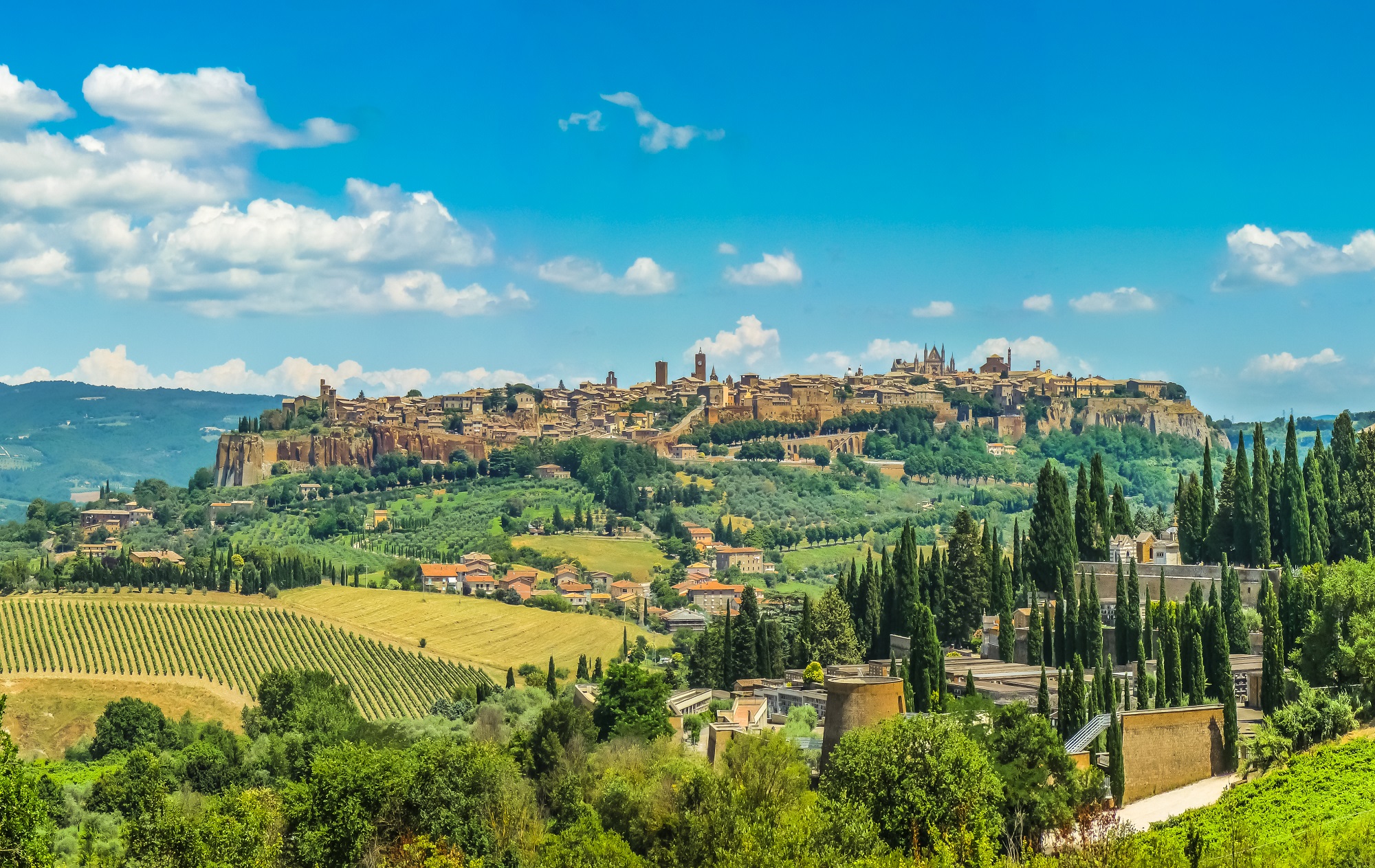
A land of lush rolling hills, ancient medieval villages, delectable wines, and sumptuous regional cuisine, Umbria bears more than a passing resemblance to its larger neighbor. Yet this captivating region is no Tuscany: Umbria offers a distinct winemaking culture with a mosaic of unique terroirs, winemaking traditions, and grape varieties. Unlike Tuscany, it is relatively undiscovered and free from the encumbrances of mass tourism. Umbria is Italy’s fifth-smallest region.
However, winemakers in this landlocked part of Italy are undergoing a period of exciting change as Umbrian wines become more known and respected on the world scene. Come witness the revolution.

History
Vines have been cultivated in Italy’s green heart since the time of the Etruscans. The Etruscans controlled Orvieto during the ancient period, building magnificent cellars cut into the volcanic rock of its dramatic hilltop.
After the fall of the Western Roman Empire, viticulture survived under the stewardship of the monasteries. By the Middle Ages, Orvieto’s sweet white wines had acquired a reputation far beyond Umbria, finding favor at papal and aristocratic tables. Umbria eventually became absorbed into the Papal States, although papal rule was interrupted by French occupation and its incorporation into the Napoleonic Empire.
After papal control was restored, Umbria joined a united Italy in 1860 during the Risorgimento. A century later, investment came flooding into its vineyards, encouraged by the growing market for premium Italian wine.
Geography and terroir
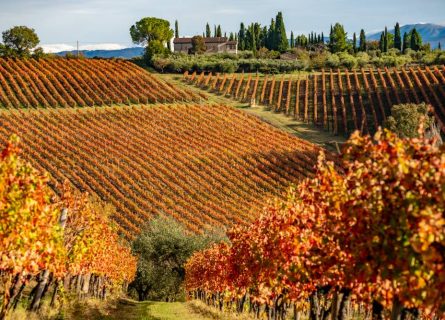
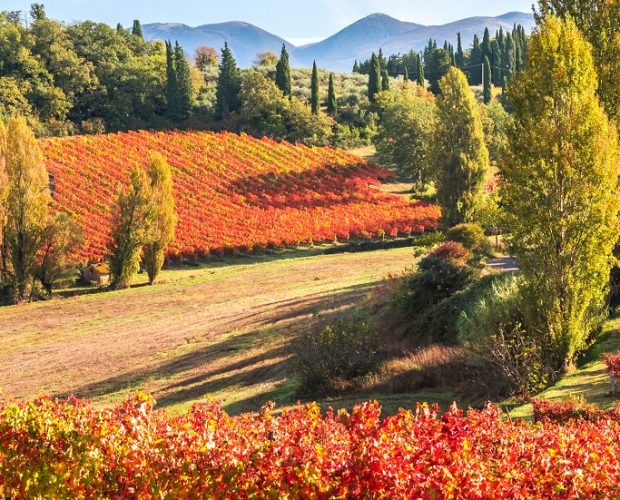
Umbria has the unique distinction of being the only Italian region without a coastline or international border. However, its landscape and climate are very similar to those of Tuscany: gently rolling hills covered in vines, olive groves, and cypress trees. Historically, Umbria was overshadowed by the untouchable glamor of Tuscany, a region adored by tourists and oenophiles alike. Yet buyers and consumers are now discovering this beautiful and lesser-known region, bordered by Tuscany to the west, Marche to the east, and Lazio to the south.
Much like the rest of central Italy, Umbria experiences mild winters and hot summers, rising to over 35 °C (95°F) in some places. Yet elevation is not the whole story: white varieties also thrive around Orvieto and in the lower-lying parts of the Spoleto valley, while Lake Trasimeno—Italy’s fourth-largest lake—moderates the climate of nearby vineyards. And, like Tuscany, diurnal temperature variation (a significant difference between daytime and nighttime temperatures) can make or break a vintage. If the nights are cool, growers can harvest ripe berries packed full of essential acidity.
Today, Umbria’s greatest gift to the world of wine is undoubtedly its aromatic and full-bodied whites. Montefalco Bianco DOC is one of the lesser-known yet most promising of Umbria’s up-and-coming appellations. Located to the southeast of Perugia, the vineyards are largely planted with a mixture of Trebbiano Spoletino and Grechetto.
The best examples offer a nutty intensity and expressive bouquet of stone fruit, tomato leaf, and lemon; the neighboring Spoleto DOC specializes in Trebbiano Spoletino. But, in terms of sheer volume, at least, Montefalco is dwarfed by Umbria’s most popular style, Orvieto. The vineyards are found in the southwestern corner of Umbria, extending into the neighboring province of Lazio. After a series of updates to the DOC regulations, the indigenous Grechetto and Trebbiano Toscano can be blended with French varieties like Chardonnay, often to the wine’s benefit. Nevertheless, there are still too many poor whites flying the Orvieto flag today, despite overall improvements to winemaking and viticultural management.
Fortunately, the same cannot be said for the stunning red wines of Montefalco Sagrantino DOCG. This thick-skinned red grape is one of Umbria’s finest, packed with flavor, tannin, and potential longevity. Traditionally, Sagrantino was closely associated with sweet passito wine, although dry versions were also produced. In the late 1980s and early 1990s, Marco Caprai helped bring the grape to international attention with bone-dry reds of considerable power and extract. Their vivid fruit, formidable tannins, and capacity to age have established Montefalco Sagrantino as Umbria’s flagship red.
In contrast, the Montefalco DOC appellation encompasses both red and white wines. Montefalco Rosso must contain 60–80% Sangiovese and 10–25% Sagrantino, while other permitted non-aromatic red varieties may complete the blend. The best vineyard sites yield very fragrant and elegant reds that combine the best elements of Chianti Classico and Montefalco Sagrantino: deep color, good concentration, and red-fruit aromatics. Like the vast majority of Umbria’s viticultural output, they are seldom overpriced.
Meanwhile, the exceptional wines of Torgiano, close to Perugia, could easily be described as “Super Umbrians.” The best reds are either velvety Bordeaux-inspired blends, generally sold under broader classifications, or the more traditional Torgiano Rosso Riserva DOCG. The latter is based on a minimum of 70% Sangiovese and aged for at least three years, including at least six months in bottle. The DOCG rules do not require 12 months in wood. There is also a healthy amount of buttery Chardonnay and aromatic Sauvignon Blanc made in Torgiano, alongside some superior Grechetto and Trebbiano Toscano blends.
Planning a Wine Trip to Umbria
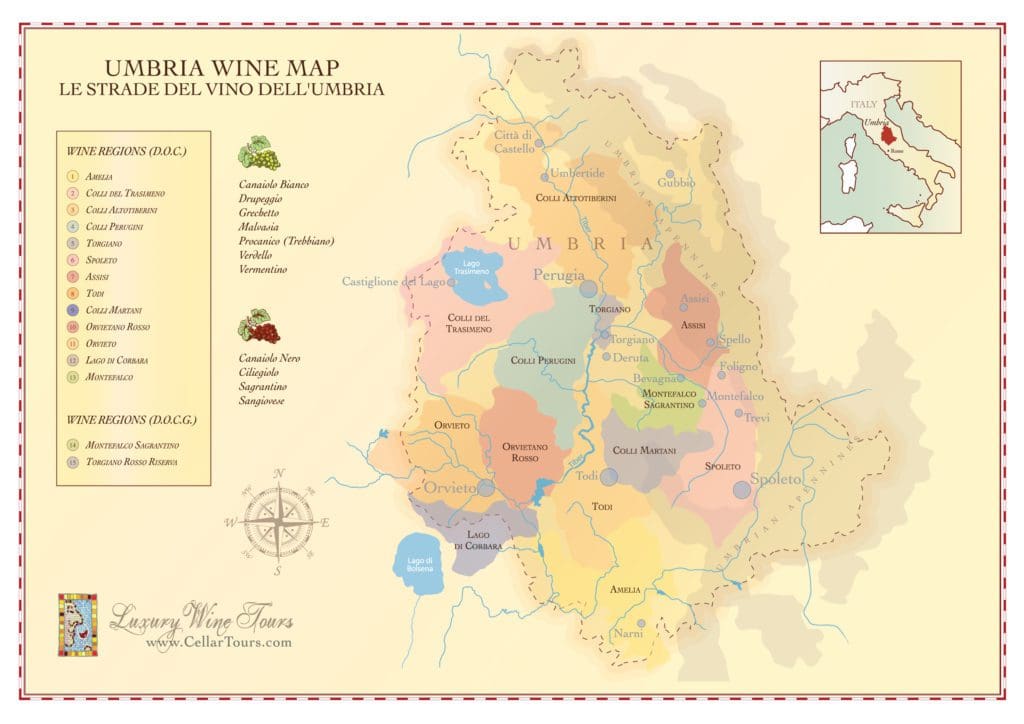
How should you approach wine touring in Umbria? The short answer is: resist the temptation of treating this region as one continuous route. Orvieto is the natural base for the vineyards of the southwest, while Perugia or Assisi places Torgiano and Lake Trasimeno within easier reach. Further south, Montefalco or nearby Bevagna works better for Sagrantino and the Spoleto valley. Distances may look modest on the map, but Umbrian hill roads obey their own timetable; attempting to combine Orvieto and Montefalco in one day will leave precious little time for an unhurried tasting—or lunch.
Please do not assume that every cellar keeps regular visiting hours. Many of the most rewarding estates receive visitors by appointment only, and two wineries a day is generally ample once a proper Umbrian lunch enters the equation. A private driver is a good idea here: generous pours, winding roads, and parking in medieval hill towns provide ample justification.
Planning resources
Winemaking and regional classifications
Can we neatly sum up winemaking in Umbria? Unfortunately, not – taking a census in a rabbit warren would be easier. The region boasts 13 DOC and 6 IGP designations, with significant differences in grape varieties and wine styles. Therefore, any attempt to pigeonhole this diverse collection of terroirs and macroclimates is bound to fail on the initial attempt.
However, there have been some broad changes to winemaking that have affected a significant number of appellations and producers in Italy. Like their Tuscan compatriots, growers in Umbria have benefited from the introduction of stainless steel and temperature control, revolutionizing the production of white wines. The old cliché of stale fruit and an oxidized, bruised apple character has been banished from the vineyards of central Italy; grapes such as Grechetto and Trebbiano Toscano (called Procanico here) yield far better wines at lower temperatures, with more fruit and precision.
However, the practice of blending different grapes has remained strong throughout Umbria’s long wine history, with the notable exception of Montefalco Sagrantino DOCG. Most of the best Umbrian reds are treated to a spell in wood, varying from 100% new French barrique to old Slavonian barrels. There has also been a return to amphorae and concrete eggs in certain quarters.
Facts & Figures
-
Key wine styles
- Full-bodied reds, aromatic whites, a tiny volume of sparkling and dessert wine
-
Appellation structure
2 DOCG, 13 DOC and 6 IGP designations
-
Hectares under vine
12,708 hectares
-
Average annual production
390,000 hectoliters
-
Approximate number of wineries
64 consortium-member wineries — Montefalco and Spoleto area, 2025
The lowdown
Italy’s only region with neither a coastline nor an international border has wine traditions that date back over 3,000 years. Yet, like so many Italian vineyards, the story of the mid-20th century was one of apathy and decline. Take Orvieto, for example, a wine-growing area with a very long and proud legacy of producing unique white wines from the Grechetto grape. Italy’s upper classes were beguiled by these concoctions of fruit, sugar, and acid for centuries – Orvieto was once regarded as one of Europe’s greatest dessert wines.
But then the fashions changed, and consumers demanded crisp, dry whites at affordable prices. Alas, Orvieto’s conversion to dry encompassed a slide into mediocrity, with large volumes of high-yielding Trebbiano Toscano substituting the vastly superior Grechetto in the blends. Stripped of its character and stymied by greed, the fortunes of this supposed leader of Umbrian wine floundered.
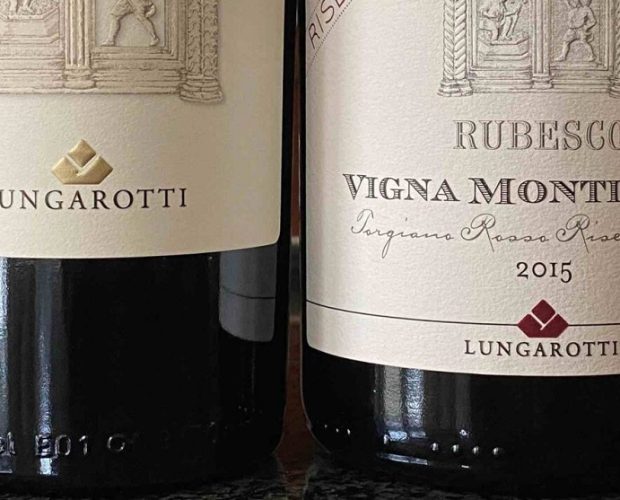
Thankfully, several pioneers and innovators rescued Umbria’s ailing reputation in the late 1900s. They included the genius Dr Giorgio Lungarotti, who, on his estate at Torgiano, was among the first to prove that Umbria could make red and white wines of depth and refinement—a rival to the best of Tuscany. His daughters, Teresa and Chiara, continue his legacy of crafting terroir-driven wines from a judicious mix of imported and local grapes.
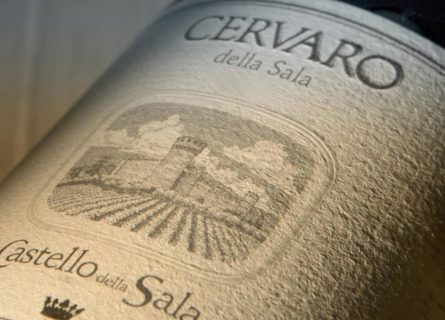
However, Lungarotti was not the only winemaker to shake things up in the vineyards of Umbria. The Antinori family has been a staunch proponent of the region, acquiring the medieval Castello della Sala estate in 1940. Updating this ancient treasure for the modern age, the oenologist Renzo Cotarella helped create a revolutionary range of white wines in the 1980s, including a barrel-fermented Chardonnay that electrified the critics. Cotarella also won high praise for the signature cuvée Cervaro della Sala, a blend of Chardonnay and Grechetto that displays a singular purity and depth rarely seen in Umbrian whites. It is now regarded as one of Italy’s greatest white wines, and with cause!
Of course, further milestones have been achieved since the first pioneers got involved. Today, Umbria markets an eclectic mix of reds and whites from grapes, both local and imported, matching specific varieties to its myriad diverse terroirs. There are skin-contact whites, biodynamic reds, and some delicious traditional-method fizz. Its key appellations remain important, although many innovators make full use of the freedom offered by the IGT framework. Umbria, once a pale shadow of the Tuscan wine scene, has arrived.
Key Grape Varietals
-
White grape
Chardonnay
Chardonnay is a green-skinned grape varietal native to the Burgundy wine region in France and one of the most popular varieties worldwide. View grape -
White grape
Grechetto
Grechetto is a white grape variety native to the central regions of Italy, particularly Umbria, and is used to make a range of wines View grape -
White grape
Sauvignon Blanc
The sauvignon blanc grape varietal, originally from the Bordeaux region of France, is now one of the world's most loved white varieties. View grape -
White grape
Trebbiano
Experience Trebbiano Toscano's Renaissance: Aromatic & Fresh Bianco Toscana IGT from Petrolo. The Future of Italian White Wine View grape -
White grape -
Red grape
Cabernet Sauvignon
Learn what Cabernet Sauvignon tastes like, where it grows best, why it matters in Bordeaux, and how to pair and serve this age-worthy red grape. View grape -
Red grape Ciliegiolo
Ciliegiolo, named for its cherry aromas, is at home in southern Umbria around Amelia and Narni, where it produces fresh, fragrant ruby-red wines. -
Red grape Gamay del Trasimeno
Despite its name, Gamay del Trasimeno belongs to the Grenache family. Around Lake Trasimeno, it produces savory, elegant reds with raspberry, cherry, and subtle spice. -
Red grape
Merlot
Merlot is the most cultivated grape in Bordeaux and closely related to Cabernet Franc View grape -
Red grape Sagrantino
Sagrantino is a red grape from Umbria, Italy, primarily cultivated in Montefalco. Its origin is unclear, possibly linked to religious or food festivals. Initially used for sweet wines,... -
Red grape
Sangiovese
Unearthing Sangiovese: Italy's Ancient Grape with a Complex History. Explore its journey from Etruscans to modern-day excellence. View grape
Umbrian gastronomy
Although it may be invidious to say so, Umbrian cuisine is every bit as exciting – and varied – as that of its more famous neighbor. Every city and subregion has its specialties: strangozzi alla spoletina, a thin fettuccine-like pasta with tomato, garlic, and chili pepper, is the dish of choice in pretty Spoleto. But there is plenty more to whet your appetite: black truffles from Norcia, wild boar slowly cooked in Sangiovese, and Regina alla porchetta (roasted carp stuffed with garlic, fennel, and herbs). Wash it down with a Torgiano Riserva and marvel at that spectacular view. Mealtimes in Umbria are always a leisurely affair.
A Guide to the Gastronomy and Cuisine of Umbria: Read more
Wineries Recommended by Cellar Tours
- Falesco Discover Falesco Winery's perfect blend of heritage and innovation with its cult wines and ancient varietals from Umbria-Lazio View winery
- Lungarotti Explore Lungarotti Winery: Umbrian vino excellence, historic Torgiano, iconic Rubesco. A must-visit for wine lovers. View winery
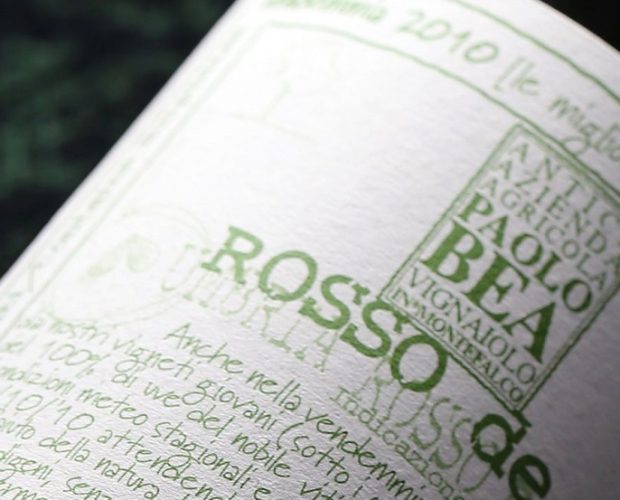
- Paolo Bea Explore Paolo Bea's organic winemaking in Umbria. Taste the acclaimed Sagrantino, steeped in tradition and the essence of Montefalco's terroir. View winery
Further Reading
Verdicchio Grape Variety: Conquers All
January 20, 2023
Verdicchio Wine: Italy's Fresh and Lively Whites. Discover the Crisp Elegance of Verdicchio from Marche and Veneto
Read article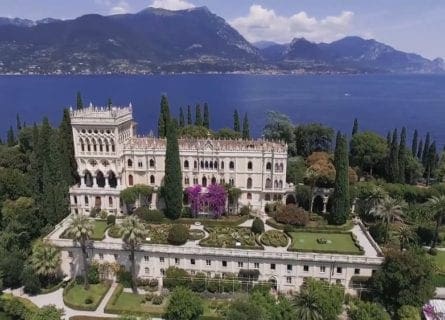
Italy’s Enchanting Castles: Top Stunning Rentals for a Royal Stay
July 13, 2020
Discover Italy's most stunning castle rentals: A blend of historical elegance and modern luxury for an unforgettable, royal-like stay.
Read article
Guide to Italian White Wine
February 4, 2023
Discover Italy's White Wine Renaissance: From Rustic Plonk to Fine Elegance. Explore Italy's Terroir, Diversity, and Quality. Cheers to Italian White Wines!
Read article
Guide to Italian Red Wine
December 8, 2021
Discover the richness and diversity of Italian red wine. Explore indigenous grape varieties and esoteric wine styles in this comprehensive guide.
Read article
Insiders Guide to Truffles in Italy
November 27, 2013
Explore Italy's truffle hunting traditions with Natale and Giorgio Romagnolo as guides, uncovering the mystique of these prized delicacies from Piedmont to Umbria.
Read article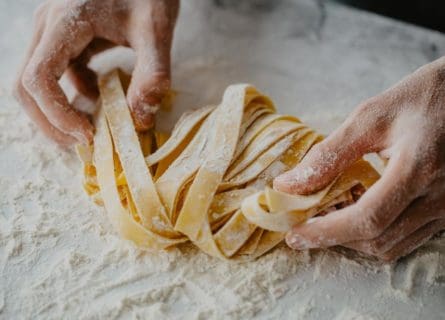
Unravel Italy’s Culinary Tapestry: A Dive into Delicious Cuisine
September 14, 2021
Discover the authentic flavors of Italy beyond pizza & pasta! Explore regional specialties, fresh ingredients, & rich culinary traditions. Immerse yourself in Italian Cuisine now!
Read articleAuthor