 46 tours
Country tours
Private Wine Tours in Italy
Private, Chauffeured Wine Journeys Across Italy’s Finest Regions
Explore the unique characteristics of Valtellina wine, a gem shaped by traditional cultivation methods and stunning landscapes.
In Gradi (“Degrees”), a documentary on Italian wine and climate change produced by the digital media company Will Media in collaboration with FIVI, the federation representing independent Italian winegrowers, there is a scene shot in the Valtellina region that sets the tone. The view rises above the terraces, filmed from a drone: lines of dry-stone walls, stacked one above the other, holding the slope in place. Then the camera drops back to ground level and follows two workers climbing the hill, each with a basket on their back. At least it is empty on the way up: it will be full of grapes on the way down, a small consolation.
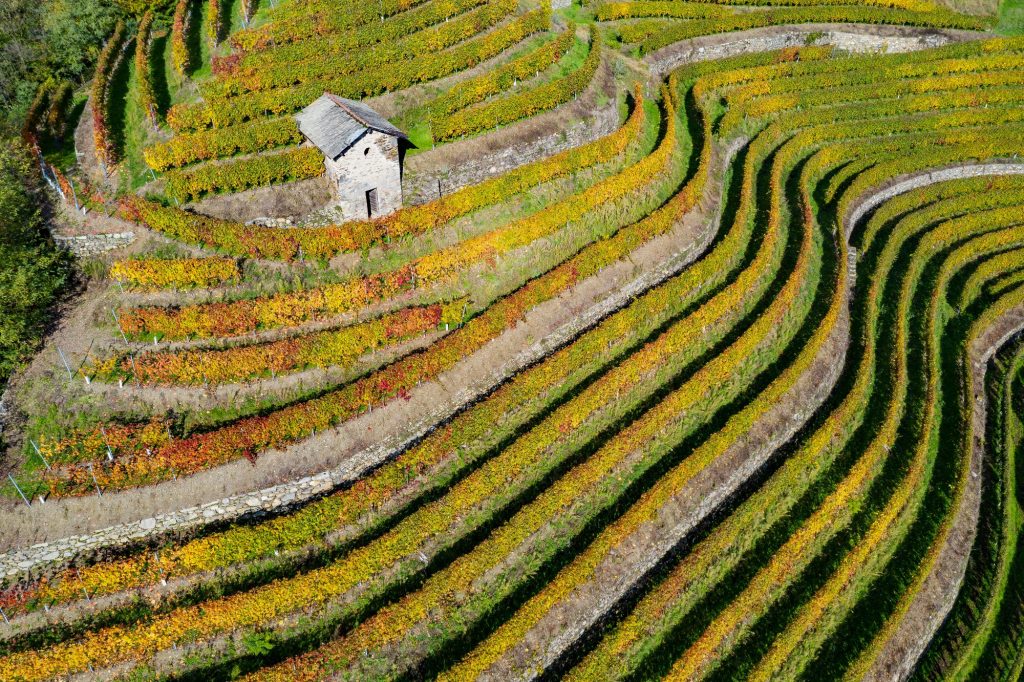
These walls are built dry, without mortar, relying only on balance, weight, and internal tension. They are what make cultivation possible here. Access is only on foot, whether to repair a collapse, tend the vines, or – as we see in the scene – carry the harvest back to the cellar. The terrain decides how long each task takes, and there is no shortcut around it.
Years ago, I took part in a Slow Food educational trip in Piedmont about Nebbiolo. We had lovely early-spring weather, yet one of the participants – a restaurateur from Valtellina – was always looking for patches of shade to shelter. As soon as a sunray caught him, he would complain about the heat, and among the rest of the group, it became a running joke to expect his frustrated remarks the moment the sun appeared. It took me a while to make sense of his idiosyncrasy.
Valtellina is a valley, but it runs east to west, not north to south, so light does not fall evenly: some slopes – like the one where that restaurateur lived! – remain in shadow for months at a time, while others receive uninterrupted exposure. The difference determines ripening, water stress, and the rhythm of work: in the same stretch of land, vineyards can move through the growing season at different speeds, sometimes within a short distance of one another, shaped more by exposure than by altitude.
Light is only one axis along which the valley unfolds. The other is verticality. This is the context in which Valtellina is often described through the language of “heroic viticulture.” Vines are cultivated on slopes exceeding 30% gradient, held in place by more than 2,500 kilometers of dry-stone walls, often described as the largest area of vertical viticulture in Italy.
Mechanization is largely impractical, and in some areas, annual labor requirements reach 1,400 hours per hectare. These conditions, which are not unique to Italy nor exclusive to Valtellina, fall within the criteria recognized by UNESCO for the protection of extreme agricultural landscapes, and the craft of building dry-stone walls is recognized separately, across several Mediterranean countries. Valtellina combines both, which means combining two layers of difficulty: cultivating on steep ground and maintaining the structures that make that cultivation possible.
And yet, within Valtellina, the term “heroic” is often received with caution. In researching this article, it repeatedly surfaced as something producers tolerate rather than embrace. The website of Nino Negri describes mountain viticulture as something that “some define as heroic, but which for us is simply our way of making wine.” The distance is telling: the word “heroic” suggests exception, solitude; it pulls the focus toward personal endurance, leaving the broader structure of the work in the background.
What many in the valley seem to resist is not the description of hardship, but the way it risks flattening their work into an image. The slopes are a workplace, the walls are systems that need to function. To call this heroic can sound like an acknowledgment of effort without addressing what that effort costs or how it should be sustained.
This will be addressed later in the article: first, by looking at how these wines are priced, and then by examining how access to new vineyard technologies is limited by regulation. For now, what matters is that in Valtellina verticality is not an image: it is the condition that work must answer to, day after day.
2,500 Kilometers: The total length of the valley’s dry-stone walls—longer than the entire Italian peninsula.
1,400+ Hours: The manual labor required per hectare, per year. (For context, a flat vineyard in Tuscany takes about 250 hours).
70% Gradient: The extreme steepness of the slopes, necessitating the use of “monorail” carts and helicopters for harvest.
The “Dark Side”: Locals call the south-facing side of the valley the “Orobic” side. Because it stays in shadow, it is used for forests and livestock, while the north (Rhaetian) side is reserved for the sun-hungry Nebbiolo.
The Mediterranean Mirage: Despite being in the Alps, the valley’s unique “solar pocket” effect is so strong that prickly pears, agaves, and olive trees grow naturally alongside the vineyards.
When I first visited Arpepe years ago, Giovanna Massera spoke about the early years without nostalgia. She had worked alongside her husband, Arturo Pelizzatti Perego, during the phase that followed the sale of the family brand “Pelizzatti” , when the winery was rebuilt from the vineyards with little capital and no safety net. “Everyone kept telling us to release the wines sooner,” she told me in the cellar. “The accountant was particularly vocal”. Arturo’s answer, she said, didn’t change for years: the wines were not ready. So they waited.
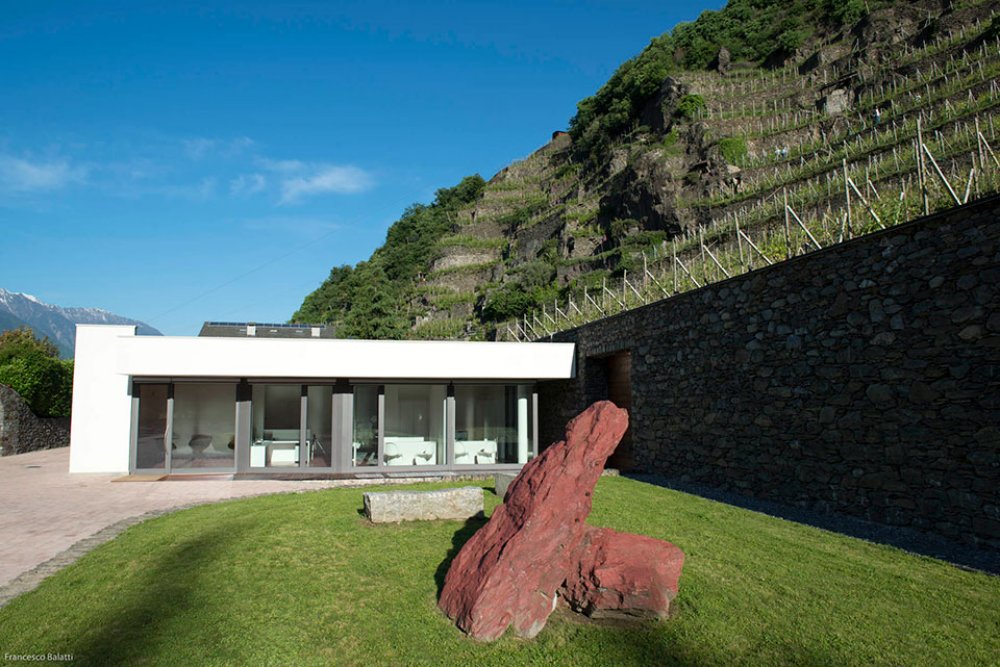
Waiting meant postponing income again and again, at a time when there was no certainty that the market would ever accept that choice. Arpepe eventually built a following willing to pay for wines released long after harvest, and today that outcome is frequently cited as evidence that patience pays. Still, wine sat immobilized for years while expenses accumulated.
In recent years, a small number of Valtellina wines have reached price levels that would have seemed implausible not long ago. A Rosso di Valtellina above twenty euros on the shelf is no longer unusual, and some Riserva bottlings now sell well above eighty. For those estates, demand exists and can be defended over time. For the region, the picture is less stable: a single producer may occupy a narrow position for a time, but a denomination built on steep slopes and sustained labor cannot move in lockstep without increasing its exposure.
In my opinion, the story of Arpepe matters not because of their success, but because it reveals the cost of that success. How widely that model can be extended across Valtellina remains an open question.
The terraces of Valtellina are often read as a landscape. In practice, they are structures built to keep steep ground in place. When viticulture expanded here in the nineteenth century, every vineyard depended on walls that had to be constructed and repaired by hand. As cultivation gradually retreated over the twentieth century, many of those structures fell into disrepair.
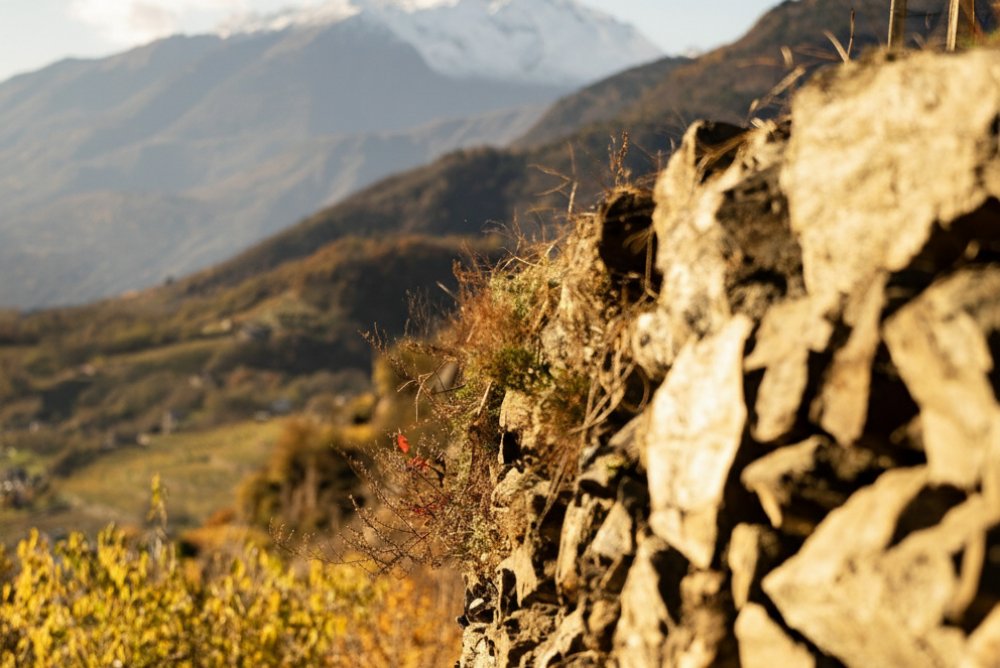
Today, vineyards are concentrated in the most favorable areas; elsewhere, abandoned terraces are common. When vines disappear, walls are no longer maintained. Soil shifts, and water follows paths it was previously guided away from. Vegetation takes over unevenly, without the checks that cultivation had imposed.
Forests are widely and rightly seen as a positive presence, and concern tends to focus on deforestation. Less attention is paid to reforestation driven by agricultural abandonment. In mountain areas like Valtellina, this process needs to be managed: without terraces and cultivated roots, slopes become more vulnerable.
Here, the vineyard functions as infrastructure: walls regulate water flow, roots stabilize soil. As long as both are present, the system endures. When maintenance stops, collapse happens in two ways, as Hemingway famously said about going bankrupt: “gradually, then suddenly”.
In Valtellina, Nebbiolo is traditionally called “Chiavennasca”: the local name suggests a separate identity, but ampelographic research has clarified that it is the very same grape. And yet, Nebbiolo in Valtellina behaves very differently than elsewhere.
In an article published on the Italian wineblog Intravino in October 2025, the question was posed as a provocation: Are the reds of Valtellina the whites among Nebbiolos? Despite the fact that by the end of the piece, the answer is no, the framing points to something real.
Ripening in Valtellina happens under constraint: altitude and exposure stretch the growing season, and accumulation proceeds at a measured pace. Tannins tend to form with a finer grain, while acidity remains active, giving the wines their sense of lift. Structure is present early, but it does not present itself as weight.
This is why these wines are often misunderstood when young: familiar markers of seriousness are subdued, even when the internal framework is already in place. With time, that framework becomes legible without changing its nature.
While the high altitudes of Valtellina create a signature elegance across the region, the wines are further defined by five specific ‘Crus’ (sub-zones). Here is a quick guide to the most famous three mentioned in the context of top producers like Arpepe and Nino Negri
| Sub-zone | Character | Best For… |
|---|---|---|
| Sassella | Elegant & silky | Fine dining |
| Grumello | Bright & aromatic | Mid-range aging |
| Inferno | Powerful & grippy | Hearty meat dishes |
| Valgella | Soft & approachable | Early drinking |
| Maroggia | Rare & nuanced | Collectors |
* Note: Look for Arpepe’s single-vineyard bottlings for a masterclass in Sassella and Grumello.
Many years ago, I took part in a small Arpepe vertical in Livigno: rather than a formal retrospective, it was a handful of older bottles opened together, some coming from the cellar, others brought by collectors who were also close to the family. For many years, Arpepe did not keep a formal archive of old vintages: bottles were not set aside with a specific plan in mind, and there was no separate cellar devoted to past releases.
The older vintages had aromas of stone, dried herbs, iron, and citrus peel. Tannins felt worn into shape. Acidity remained, keeping the wines upright even as the fruit receded.
Ultimately, what stayed with me most was the atmosphere, particularly when the bottles were opened, and Emanuele and Isabella Pelizzatti Perego were noticeably moved, perhaps by the memory of their father, Arturo Pelizzatti Perego, who died prematurely in December 2004. They are carrying forward a project inspired by his conviction that time was not a promise, but a given.
In that sense, the belief that the wines would age did not coincide with a clear expectation that anyone would one day ask to drink them that way. This is how time functions in Valtellina.
The idea that altitude can offer protection against climate change is one of the most persistent clichés in contemporary wine discourse. The documentary “Gradi” – mentioned earlier – takes that suggestion apart.
In Italian, the word “gradi”, much like the English degree, carries three meanings at once: it can refer to temperature, to alcohol content, and to the angle of a slope. In Valtellina, all three meanings apply.
The episode dedicated to the valley focuses on how these three “degrees” interact and why altitude does not offset climate change. Through the voice of Emanuele Pelizzatti Perego (him again!), the film shows how climate pressure here has changed form. Heat spikes arrive earlier and are more abrupt. Rainfall is less predictable and more violent, increasing the risk of erosion on slopes. Drought is no longer seasonal but intermittent, complicating decisions around intervention.
Gradi follows, among other things, a long local trial on drones for phytosanitary treatments (plant health). In steep vineyards, where tractors are useless, drones could offer a way to intervene at the right moment, using less water and, at times, operating within the narrow windows of night or early morning. But regulations still tend to treat a drone like a helicopter, with procedures and regulations that make sense on flat land but become disproportionate on steep slopes. The region’s producers and local bodies have been pushing for exemptions that reflect how work is actually done here.
In Valtellina, the marks of traditional viticulture – such as long ageing and cement vats – coexist with innovation for pragmatic reasons. Gradi makes a simple point: altitude changes the terms of the problem but does not in any way remove it, and the pressure shows up in logistics, timing, and risk.
At Arpepe, the passage of time is evident in how the wines are made and released: fermentations are long, and bottlings reach the market years after harvest. Over the last two decades, the work has focused on refining control to the minutest details in the vineyards and cellar, while keeping the original stylistic framework intact.
Nino Negri operates from a fifteenth-century palazzo in Chiuro: their cellars extend through several underground levels. Founded at the end of the nineteenth century, the estate has developed alongside the formal recognition of Valtellina wines: its history is tied to the development of the denomination.
One name that has clearly moved beyond the “emerging” category is Dirupi. When I first visited in 2010, the project was still operating out of a former shepherd’s stone hut, equipped with the bare minimum (incidentally, it was Emanuele Pelizzatti Perego who suggested I go and see them during a visit to Arpepe).
The name “Dirupi” refers to the steep slopes that define Valtellina: behind the winery are Pierpaolo Di Franco and Davide Fasolini, known as Birba and Faso, who were young winemakers when Dirupi was founded. Their first labels showed two black silhouettes, one tall and thin, the other shorter and stockier, drawn almost like cut-outs, with the handwritten word dirupi underneath. In a territory where producers are often identified by noble lineages, such as the Conti (“Counts”) Sertoli Salis, the contrast was immediate.
Today, Dirupi is based in Ponte in Valtellina, in a sixteenth-century palazzo owned by the municipality. The trajectory may look like a move from rags to riches, but the work has not: seven hectares of vineyards divided into more than twenty small parcels, planted on steep terraced slopes with gradients that can reach seventy percent (the visual language has changed as well: the early labels with the silhouettes of Birba and Faso have given way to a more… institutional design).
In Italy, the current popularity of Valtellina has coincided with (I’m not saying it directly caused) a drastic price hike. For a small number of producers, this has worked: Arpepe or Dirupi can sustain high prices because demand exists. But it is very specific: when other Rosso di Valtellina or entry-level Superiore bottles cross price thresholds associated with fine-wine categories, some critics have begun to wonder whether the denomination as a whole can follow that trajectory. Or more radically: should it?
The situation is complicated by the fate of Sforzato. Long considered the pinnacle of Valtellina production and traditionally its most expensive wine, it now sits uneasily in a market (his case is similar to Valpolicella’s Amarone, a powerhouse in the ‘90s and early ‘00s) that increasingly values lower alcohol and drinkability. This shift has weakened Sforzato’s role as a flagship, capable of pulling the rest of the region upward.
Internationally, it feels like the global Nebbiolo boom has helped, but attention remains concentrated elsewhere, such as in Alto Piemonte, where pricing is perceived as more aligned with what people are willing to pay. Valtellina finds itself in a tricky position. Its wines are no longer overlooked, but they are not yet anchored to a shared idea of value. Production costs are very high and rising steadily.
Valtellina is ultimately posing a question of value, not in terms of reputation or scarcity, but in the most basic sense: the cost of keeping work possible over time (the French use the term durabilité instead of “sustainability”: meaning the ability of a practice to endure without breaking the land – and the people – that sustain it).
When wine is judged solely by how well it performs as a product, places with slow, physically demanding production will struggle. The famous food writer Wendell Berry wrote that eating is an agricultural act, the final step of a process that begins with soil and labor. Drinking wine is the same. But another step comes earlier: paying. Paying is also an agricultural act, because it determines whether that labor can continue.

Explore further
Discover private journeys, regional guides, and expert stories to help you plan an unforgettable trip through Italy.
46 tours
Private, Chauffeured Wine Journeys Across Italy’s Finest Regions
 1 day (ideal from Umbria)
Truffle hunting, regional wines and hands-on cooking.
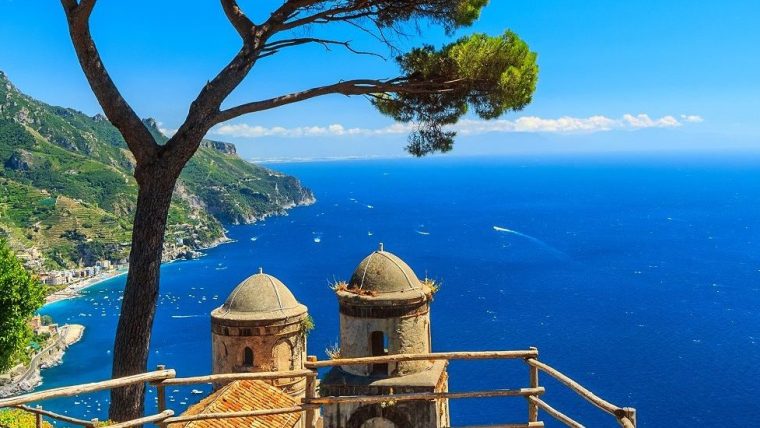 1 day (ideal from Ravello)
Aglianico, Fiano and Amalfi Coast wine country from Ravello.
Compare Italy’s leading wine regions by signature wines, scenery, best base, travel time and ideal stay
Explore regions
Explore the beauty of Franciacorta and discover the unique qualities of Franciacorta sparkling wine from Northern Italy.
Read article
Decode Italian wine labels easily with our guide. Understand symbols, terms, and traditions to enhance your wine experience.
Read article