Alsace Wine Region Guide
Riesling, Grand Cru Vineyards and the Alsace Wine Route
Introduction
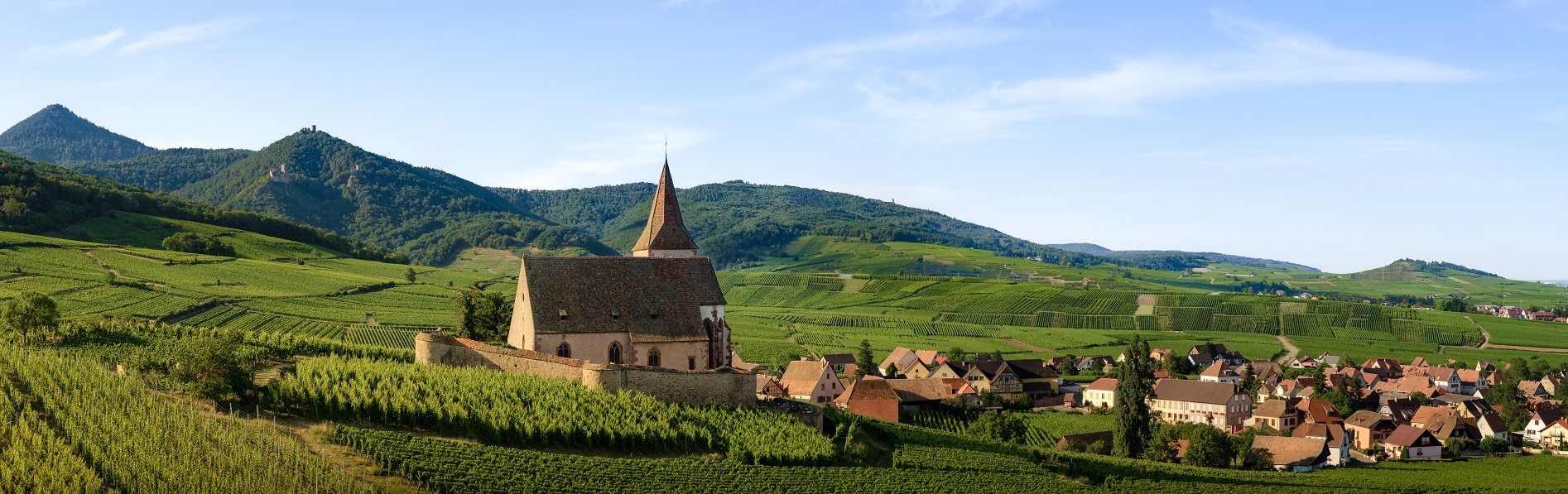
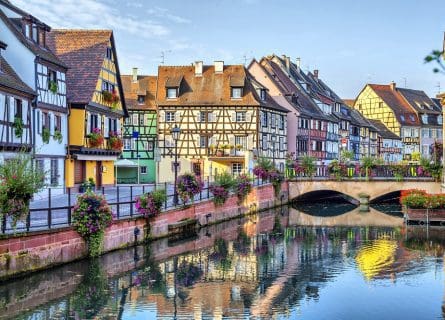
Alsace is unlike any other French vineyard. Its history, scenery, and cultural heritage are unique. Located between the Vosges Mountains and the Rhine River, Alsace has long been a melting pot of French and Germanic influences. The region’s signature grape variety, Riesling, most obviously demonstrates this. Alsace is France’s principal source of Riesling, a variety also ubiquitous across the border in Germany. Popularly known as the land of storks’ nests and photogenic half-timbered houses, Alsace is celebrated for aromatic white wines that typically emphasize fruit, grape variety, and terroir rather than overt oak.
Wine tourists have long adored the place; its chocolate-box villages, delicious gastronomy, and undulating landscape are irresistible. But this vineyard is far more than tourist-centric—widely acclaimed Alsatian whites are enjoyed worldwide. Renowned for superlative still and sparkling wines, Alsace also produces increasingly ambitious Pinot Noir. Grand Cru Alsatian Riesling is unmissable. However, it is merely the tip of a large iceberg. Discovering Alsace will take a while.
Discover More About French Wine
History
Alsace has long been a European melting pot, dating back to the arrival of the Celtic Gauls in the 1st millennium BC. This proud culture fought bravely against the superior forces of Julius Caesar during the Roman Gallic Wars.
However, Caesar’s armies ultimately emerged victorious in 50 BC. The Western Roman Empire absorbed Gaul (modern-day France), and it remained an important part of the Roman administration for over four centuries. Yet from the 4th and 5th centuries AD, Germanic tribes destroyed much of the Roman legacy.
After the Thirty Years’ War (1618-48), the Treaty of Westphalia awarded most of Alsace to the French crown. Alsace was a vital part of the French wine economy by the time of the French Revolution. Unfortunately, the Franco-Prussian War of 1870-71 did not end well for the French state.
Under the Treaty of Frankfurt in 1871, most of Alsace was ceded to the German Empire. Following Germany’s defeat in the First World War, Alsace returned to French control. Constant shelling and the horrors of trench warfare destroyed many vineyards during the conflict.
However, the second half of the 20th century saw many positive changes in Alsace. The Alsace AOC was recognized in 1962, followed by the first Alsace Grand Cru, Schlossberg, in 1975 and the recognition of Crémant d’Alsace in 1976. The Grand Cru classification subsequently expanded to encompass 51 individual sites.
Geography and terroir

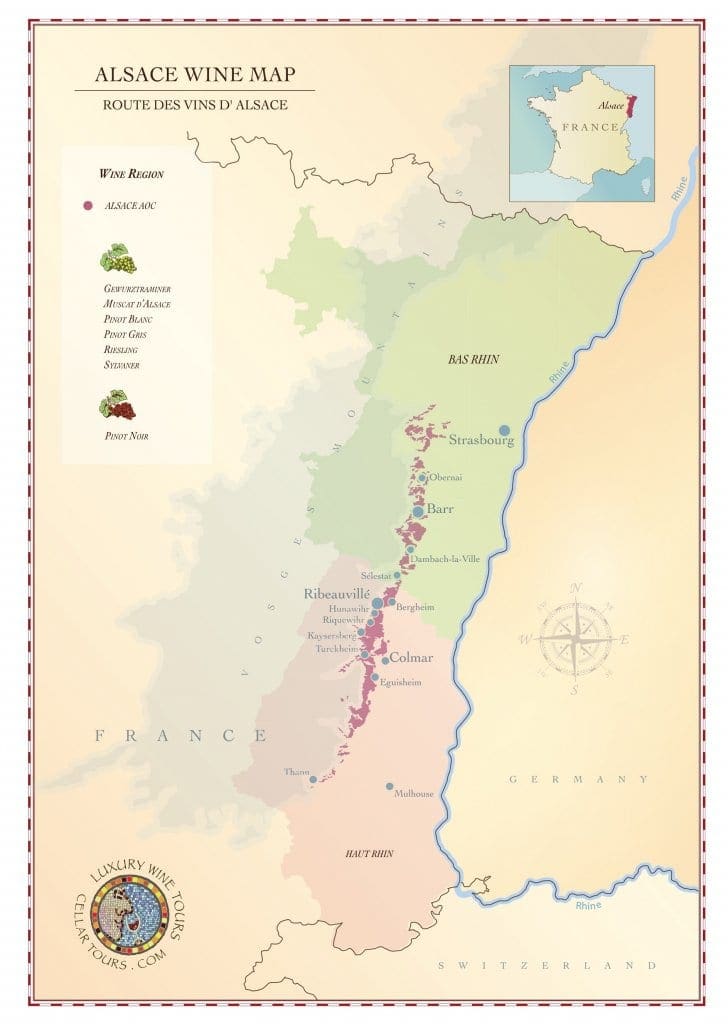
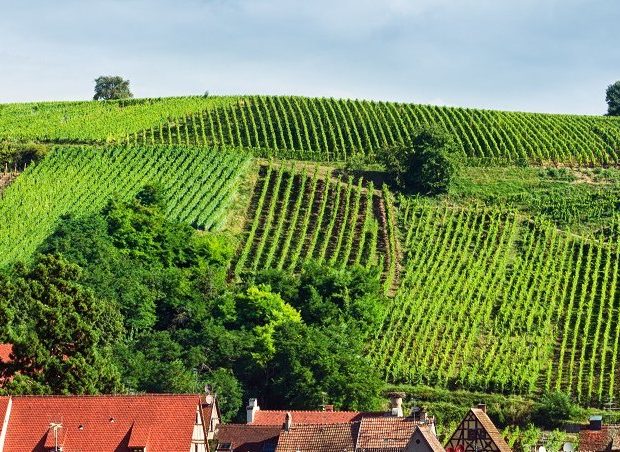
Alsace, with its charming villages and picturesque landscapes, boasts a spectacular topography. The principal vineyard corridor runs for approximately 170 kilometers (106 miles), from Marlenheim in the north to Thann in the south, with a separate northern sector around Wissembourg and Cleebourg. To the west are the Vosges Mountains, the most important element in shaping Alsace’s wine culture. Indeed, thanks to the Vosges’ natural rain shadow, varieties like Pinot Noir and Pinot Blanc can ripen in northeastern France; sunshine hours are high during the growing season, and rainfall is low.
To the east of the vineyards lie the Rhine and the German border. Diurnal temperature variation and a temperate climate are responsible for the region’s famously fresh and crunchy fruit flavors—conscientious growers in Alsace seldom produce flabby wines. Alsace’s passionate growers take full advantage of these favorable natural conditions, a true blessing for their vineyards.
Alsace’s Winemaking Landscape
The principal wine route stretches from Marlenheim in the north to Thann in the south, with the heart of the region centered around the town of Colmar. Strasbourg is the administrative capital of Alsace, with excellent transport links to the surrounding villages.
Bas-Rhin and Haut-Rhin, the region’s two administrative departments, are often used as broad geographic divisions. Haut-Rhin, further south, contains many of the best-known wine villages and a particularly high concentration of Grand Cru sites. In some respects, the region resembles the Côte d’Or in Burgundy, as many of the finest sites are on the slopes of the Vosges, with well-drained, meager soils.
A Tapestry of Terroirs: Alsace’s Diverse Soils
Meanwhile, Alsatian terroir ranks among France’s most heterogeneous, encompassing schist, granite, clay-limestone, sandstone, and volcanic soils. Consequently, Alsace offers a wide spectrum of styles, with suitable terroirs for almost every grape variety. For example, Riesling has a strong affinity with granite terrain, while Pinot Noir thrives on calcareous marls.
Grand Cru Elegance: Alsace’s Treasured Vineyards
The crème de la crème of Alsatian terroir is found in the region’s 51 delimited Grand Cru sites. Since 2011, each has been protected as an individual Alsace Grand Cru appellation, with rules covering grape varieties, yields, and production methods. Some of the best-known sites include Altenberg de Bergheim, Brand, Geisberg, Goldert, Kirchberg de Barr, and Vorbourg. Depending on the permitted grape variety and harvest conditions, Alsace Grand Cru wines may also carry the Vendanges Tardives or Sélection de Grains Nobles designation.
Clos Sainte Hune: A Legendary Vineyard in Alsace
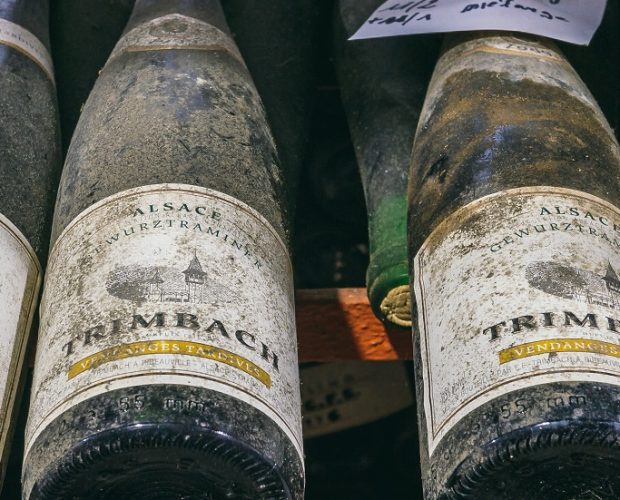
One of Alsace’s most celebrated vineyards is Clos Sainte Hune. Long owned by the Trimbach family, this celebrated Riesling vineyard lies within the Rosacker Grand Cru. Journalists, buyers, and critics regard Clos Sainte Hune as one of the world’s greatest expressions of the noble Riesling grape.
Planning a Wine Trip to Alsace
When wine touring in Alsace, Colmar is the natural base for the celebrated villages and Grand Cru vineyards of central Alsace, including Riquewihr, Ribeauvillé, Kaysersberg, and Eguisheim. Strasbourg works better for the northern vineyards around Marlenheim, Molsheim, and Barr. Do not attempt to cover the entire 170-kilometer Wine Route in a day; two days is the sensible minimum, while three days is preferable, permitting unhurried tastings, proper lunches, and time to explore the villages on foot.
Many of the most rewarding estates are family-run and receive visitors by appointment. Two wineries a day is generally ample, and a private driver is not a luxury on winding vineyard roads when generous pours of Riesling, Pinot Gris, and Crémant enter the equation.
Planning resources
Winemaking and regional classifications
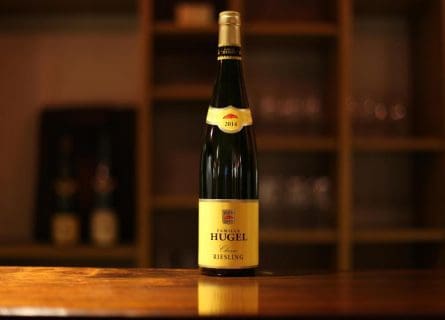
The Alsatians continue to maintain heterodox views on the importance of varietal labeling. Alsace breaks the mold with an approach in which grape varieties, displayed prominently on labels, take center stage. This differs from Burgundy, where appellation and vineyard origin generally take precedence.
However, Alsace makes up for it with its renowned consistency in quality. Although there are some substantial merchant operations and large wine cooperatives in the region, Alsace is not primarily associated with bulk wine. In every sense of the word, Alsace is unique among French vineyards.
Dry Riesling: Alsace’s Signature Elegance
Today, Alsace continues to produce a wide range of styles. These include traditional-method sparkling wine, rosé, fragrant Pinot Noir, and late-harvest wines labeled Vendanges Tardives or Sélection de Grains Nobles. Yet, for most consumers, Alsace is France’s premier source of dry Riesling.
Historically, winemaking dynasties like the Hugel family would vinify their wines in large wooden casks. Fermentation temperatures would often climb above 75 degrees Fahrenheit in their ancient cellars. Such an approach has its merits: it produces a very dry, steely expression of the Riesling grape that gains complexity as it ages. However, higher fermentation temperatures can reduce certain aromatic compounds and fruity esters in the must.
Pinot Noir’s Allure
Mindful of contemporary expectations, some houses now ferment their wines in stainless steel at precisely controlled temperatures. This creates a very aromatic and fruit-forward style. Winemakers often treat other key varieties, like Pinot Gris and Gewürztraminer, similarly. As a rule, the Alsatian approach is to eschew overt oak maturation; producers want fruit expression at the forefront of their wines.
But there are exceptions: Pinot Noir and some white wines can benefit from time in barrique. Pinot Noir has become an increasingly important part of modern Alsace and can offer a distinctive alternative to red Burgundy.
Crémant d’Alsace: A Sparkling Wine with a Distinct Identity
Crémant d’Alsace is another highlight. The law mandates production through the traditional method, which involves a secondary fermentation in the bottle. This is the same method used in Champagne. However, growers work with a different palette of principal grape varieties: Auxerrois, Chardonnay, Pinot Blanc, Pinot Gris, Pinot Noir, and Riesling.
The result has its own regional identity. Crémant d’Alsace often emphasizes fresh fruit and lively acidity, although its character and autolytic complexity vary depending on the blend and the time spent aging on the lees.
Crémant d’Alsace Rosé is made from Pinot Noir. Expect red berry fruit and brilliant acidity—a refreshing summer aperitif.
Meanwhile, Alsace’s late-harvest wines remain critically lauded, although global demand has softened in recent years. Vendanges Tardives wines can range from relatively dry to sweet, depending on the producer and vintage, while Sélection de Grains Nobles is generally richer and sweeter. Produced by leading estates, these wines can offer remarkable depth and exceptional balance.
Facts & Figures
-
Key wine styles
- Dry and aromatic white wines, Alsace Grand Cru wines, Pinot Noir red and rosé wines, Traditional-method Crémant d’Alsace, Vendanges Tardives and Sélections de Grains Nobles
-
Appellation structure
- AOC Alsace, AOC Crémant d’Alsace, and 51 individual Alsace Grand Cru appellations
-
Hectares under vine
- Approximately 15,600 hectares in total, including 15,417 hectares in AOP production in 2024
-
Average annual AOC production
904,000 hectolitres—approximately 120.5 million 75cl bottle equivalents. Five-year average, 2020–2024.
-
Vineyard holdings
3,323 (2020 agricultural census)
The lowdown
Alsace has spent decades promoting its superlative wines to the world. Demand in the domestic market has always been relatively strong. Despite buoyant tourism, Bordeaux and Burgundy overshadowed Alsace for most of the 20th century. Unlike its rivals, this complex region did not generally appeal to wealthy collectors and connoisseurs.
The upside is incredible value across the board. Alsace, despite offering an array of unique flavors and complex wines, remains underpriced for the quality it delivers. More consumers are discovering just how magnificent Alsatian wine can be, although the region still sells most of its production at home. In 2024, approximately 27% of Alsace wine shipments went to markets outside France.
Alsace’s major advantage is the global popularity of fresh, saline white wines. Pinot Gris, Sylvaner, and Pinot Blanc are varieties that suit wine bars—and upmarket retailers—down to the ground. Yet the region’s signature grape remains underappreciated in some markets. Riesling has never entirely caught fire in the US, although niche demand is steady.
Crémant d’Alsace, however, is on a roll. It represented 34% of all Alsace AOC shipments in 2024, with approximately 40.9 million bottles shipped in France and abroad. The catalyst for this growth is changing attitudes to sparkling wine; consumers no longer limit their enjoyment to ‘special occasions.’ An affordable bottle of premium fizz is now a weekend treat, and Crémant d’Alsace delivers quality and value for money.
Modern Alsace produces wines for those who collect unique tastes and don’t demand blockbusters. Crémant d’Alsace, delicious and affordable, has become a poster child for this historic vineyard’s renewed confidence and swagger. Long may it continue.
Key Grape Varietals
-
White grape -
White grape
Gewürztraminer
Learn what Gewürztraminer tastes like, where it grows best, how dry or sweet it can be, and which foods pair beautifully with it. View grape -
White grape
Pinot Blanc
Pinot blanc is a white wine grape varietal, that is a mutation of Pinot noir grape. It is planted in mostly Alsace, Germany and Northern Italy. View grape -
White grape
Pinot Gris
Pinot Gris is a white-wine grape variety originally from Burgundy. It is thought to be a mutant clone of Pinot Noir. View grape -
White grape
Riesling
Discover Riesling's charm, a white grape from Germany's Rhine region, cherished in Alsace, France. Unveil its secrets and delights View grape -
White grape Sylvaner
A historic Alsace variety known for light, fresh, herbal, and mineral wines. It can achieve greater depth on old vines and is permitted in the Zotzenberg Grand Cru. -
White grape
Muscat Blanc
Muscat blanc is a white wine grape varietal popular in the Muscat d'Alsace, Moscato d'Asti and Beaumes-de-Venise regions. View grape -
Red grape
Pinot Noir
Pinot Noir is one of the world’s great red wine grapes. Learn its flavors, food pairings, key regions, Burgundy styles, Champagne role, and why it is so difficult... View grape
Alsace gastronomy
The variety of places in Alsace that offer a fine meal is enormous. Throughout the day, the ubiquitous cafés that fill every town and village are ideal for a coffee and snack. Colmar’s medieval streets are full of these charming institutions, surrounded by pastel-colored houses. But for something more substantial, seek out the region’s many excellent bistros, brasseries, and restaurants; Alsatian cuisine is rich, hearty, and immensely satisfying.
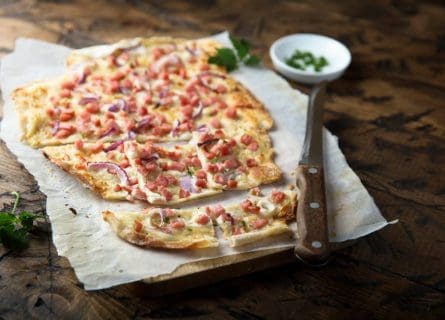
One can detect Germanic influences in many regional classics, including choucroute alsacienne: sauerkraut served with sausages and assorted cuts of pork. Visitors also swoon over fresh Flammekueche, or tarte flambée, a thin flatbread topped with crème fraîche, sliced onions, and lardons. Another regional favorite is Coq au Riesling, Alsace’s white-wine interpretation of coq au vin, often enriched with cream and mushrooms.
Recommended Alsace Wineries
Riquewihr 2 wineries
- Domaine Dopff Au Moulin A historic Riquewihr estate closely associated with the development of Crémant d’Alsace, alongside a broad range of still and Grand Cru wines. Visit website
- Hugel & Fils Uncover the legacy of the influential Hugel family, shaping Alsace's wine industry. Explore their exquisite Rieslings and world-class white wines. View winery
Turckheim 1 winery
Bergheim 1 winery
Wettolsheim 1 winery
Ammerschwihr 1 winery
Ribeauvillé 1 winery
Gertwiller 1 winery
Further Reading
Roussanne Grape Variety: Collectability Credentials
October 4, 2022
Learn about Roussanne, the elegant white grape native to Rhône. Often blended with Marsanne, explore its unique qualities and rich heritage in our guide.
Read article
French Cuisine: Explore the Diverse Dishes and Regional Gastronomy of France
December 29, 2021
Explore the art of French cuisine: from pastries to cheeses, uncover regional culinary traditions & cooking secrets in our expert guide. 🇫🇷 Bon appétit!
Read article
Navigating French Wine Labels: Expert Tips on Regions and Quality Indicators
July 24, 2024
Learn to decode French wine labels. Understand regions, rules, and quality indicators for better wine selections and appreciation.
Read article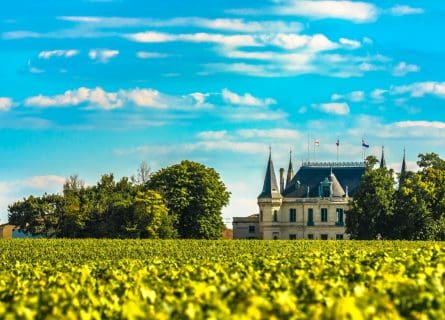
Guide to French White Wines By Region
October 20, 2022
Explore the world of French white wine and discover its diverse flavors and styles that have captivated global wine lovers.
Read article
Pinot Noir Grape Guide: Taste, Regions, Food Pairings & Burgundy
March 4, 2022
Pinot Noir is one of the world’s great red wine grapes. Learn its flavors, food pairings, key regions, Burgundy styles, Champagne role, and why it is so difficult to grow.
Read article
Gewürztraminer Wine Guide: Taste, Alsace & Food Pairings
October 16, 2022
Learn what Gewürztraminer tastes like, where it grows best, how dry or sweet it can be, and which foods pair beautifully with it.
Read articleAuthor