Where Balsamic Excellence Meets Automotive Heritage. Discover the world's finest vinegar, Ferrari's birthplace, and culinary treasures.
Cellar Tours Insight
— Since 2003, Cellar Tours has planned private food and wine journeys through the world’s leading wine regions, pairing tailor-made itineraries with VIP winery visits, fine dining, and expert regional guidance.
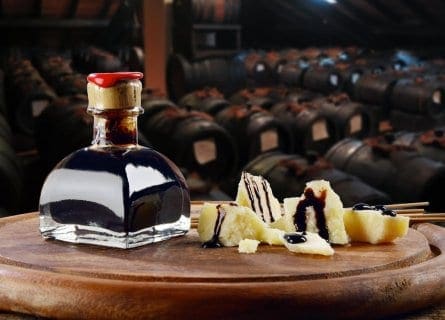
What is perhaps the world’s most expensive condiment, Aceto Balsamico Tradizionale di Modena, has put this lovely, small Italian city on the map of epicureans worldwide. It is perfection with its inky black color, pungently sweet taste, and thick, syrupy consistency. Balsamic Vinegar of Modena inspires passion in Modena – where vinegar producers carefully age their creations for decades – and beyond – where connoisseurs happily pay as much as €500 per bottle for the most elite balsamic vinegar. The delicacy is at the heart of the city’s culinary tradition and tourist trade.
Settled in the Iron Age but later abandoned, Modena was founded by the Romans (who called it “Mutina”) in 183 BC. Sitting on the southern side of the Po Valley in what is now the heart of Italy’s northern Emilia-Romagna region, this was a fertile area with an excellent transportation network. During the 14th century, the Este family came to power and held control until 1598, when the city fell to the Pope. Modena was under Austrian rule from 1814 until 1860, when the territory became part of a unified Italy.
Modena’s excellence in gastronomy is comparable only to its automotive excellence. The town is also famous as Ferrari’s birthplace and Maserati’s home. Just beyond Modena’s center stands a monument to Enzo Ferrari, who lived nearby and opened the first Ferrari office in the 1930s. The Maserati factory, still in operation, is not far away. On the outskirts of town, you can visit the Panini Museum, where a high-end Parmesan cheesemaker has a fabulous collection of Maserati cars. Another famous son of Modena is Pavarotti, the great opera tenor.
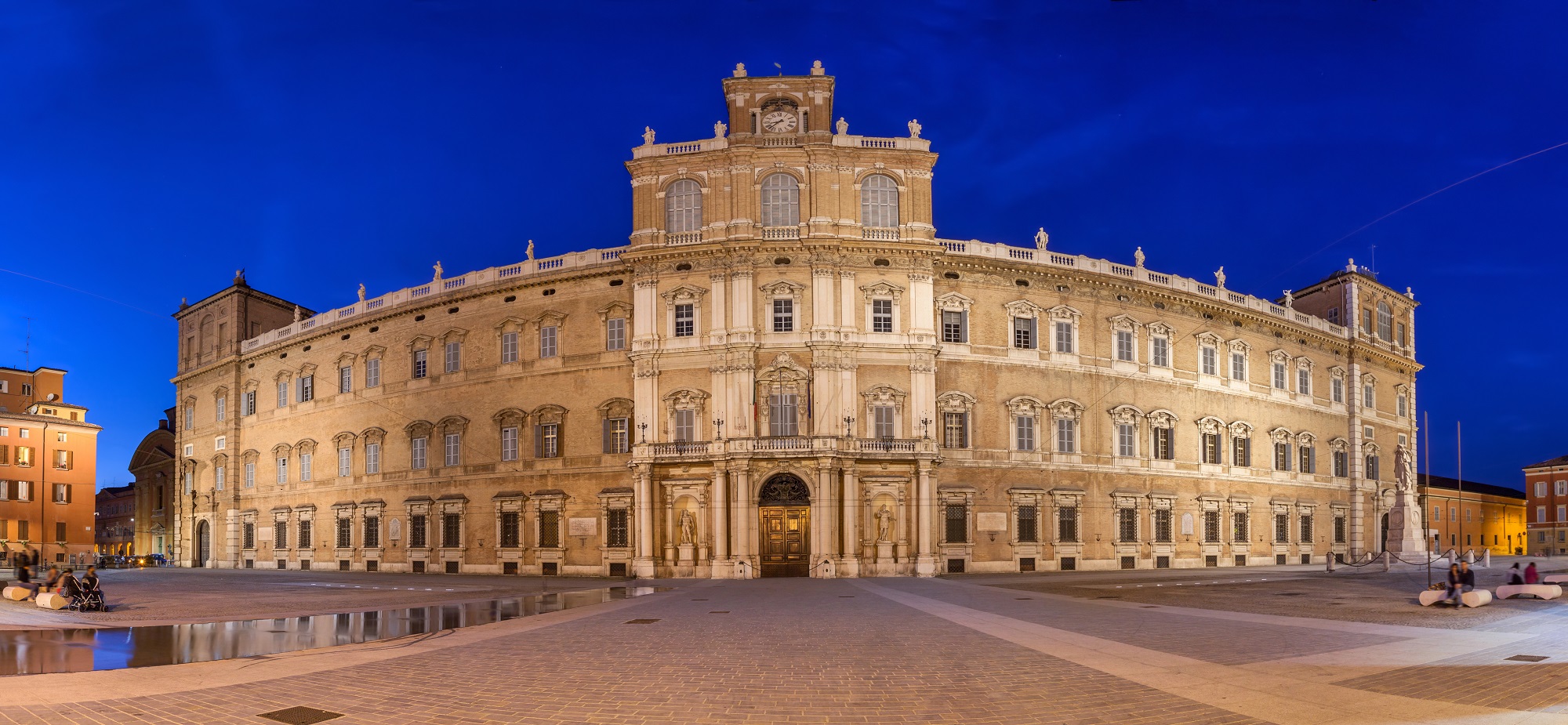
Sports cars are in evidence in Modena, but modern automobiles won’t be your focus as you stroll through the heart of the old city. Instead, headfirst to the pulsating Piazza Grande, a busy plaza ringed by the Cathedral, the town hall, and the Ghirlandina Tower. Next, stop at the city’s cultural highlight, the Palazzo dei Musei, where several museums (many of them based upon the collections of the noble Este family) showcase Italian art and artifacts.
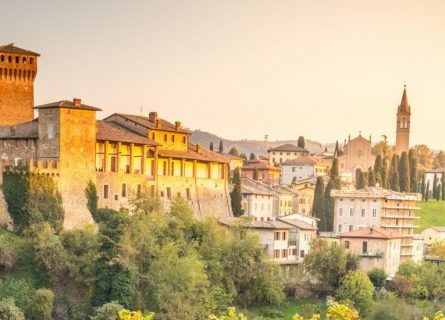
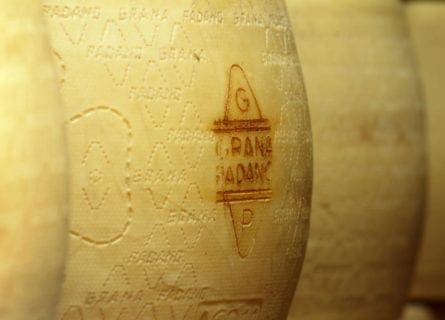
These days, Modena attracts foodies worldwide as it is on the “Gourmet Route” of Italy and home to fantastic restaurants and gourmet shops. Balsamic Vinegar, Parma and Culatello hams, and Parmigiano cheese are all locally made products in the fantastically welcoming region of Emilia Romagna.
The area’s star product is the potent aged vinegar Aceto Balsamico Tradizionale di Modena (Traditional Balsamic Vinegar of Modena). Controlled as carefully as top wines, high-quality balsamic vinegar is a thoroughly artisan product highly valued for its unique flavors and aroma. It’s used on everything from salads and cheeses to fruits and desserts.
Other local culinary delights are cotechino and zampone, two varieties of cooked and dried pork sausage born out of poverty and now prized delicacies. Prosciutto is also made here and is tightly controlled by the Consorzio del Prosciutto di Modena. Gnocco Fritto, fritters flavored with pork and fried in oil, are also popular. For dessert, try bensone, a lemon-flavored crumble.
Emilia-Romagna’s 18 DOC wines are popular in Modena. Ranging from the fizzy Lambruscos to hearty Sangiovese-based reds and the pale, dry Trebbianos, there is a bit of something for everyone. After-dinner digestives like Nocino, a spirit made with green walnuts, is the perfect way to end a traditional hearty meal served here. Checkout our Emilia-Romagna food guide
A Guide to the Gastronomy and Cuisine of Emilia Romagna: Read more
Begun in 1099 and finished a century later, this grand church boasts a beautiful rose window and three naves. It was declared a world heritage site by UNESCO.
Declared a UNESCO world heritage building, the bell tower standing near the Duomo was built in the 13th century and is one of the distinctive features of Modena’s skyline.
The “Museum Palace” is, as its name indicates, replete with art and cultural museums. The Municipal Museum, the Estense Gallery (an important Italian painting, sculpture and archaeological collection from the Este family), the Estense Epigraphic Museum and the Estense Library.
Explore Piacenza's culinary treasures in our guide. Discover Emilia Romagna's authentic flavors, from wines to artisanal cheeses. A must-read for foodies!
Explore Reggio Emilia's culinary treasures in our guide. Discover Emilia Romagna's authentic flavors, from wines to artisanal cheeses. A must-read for foodies!
To provide the best experiences, we use technologies like cookies to store and/or access device information. Consenting to these technologies will allow us to process data such as browsing behavior or unique IDs on this site. Not consenting or withdrawing consent, may adversely affect certain features and functions.
Functional
Always active
The technical storage or access is strictly necessary for the legitimate purpose of enabling the use of a specific service explicitly requested by the subscriber or user, or for the sole purpose of carrying out the transmission of a communication over an electronic communications network.
Preferences
The technical storage or access is necessary for the legitimate purpose of storing preferences that are not requested by the subscriber or user.
Statistics
The technical storage or access that is used exclusively for statistical purposes.The technical storage or access that is used exclusively for anonymous statistical purposes. Without a subpoena, voluntary compliance on the part of your Internet Service Provider, or additional records from a third party, information stored or retrieved for this purpose alone cannot usually be used to identify you.
Marketing
The technical storage or access is required to create user profiles to send advertising, or to track the user on a website or across several websites for similar marketing purposes.